 GMA
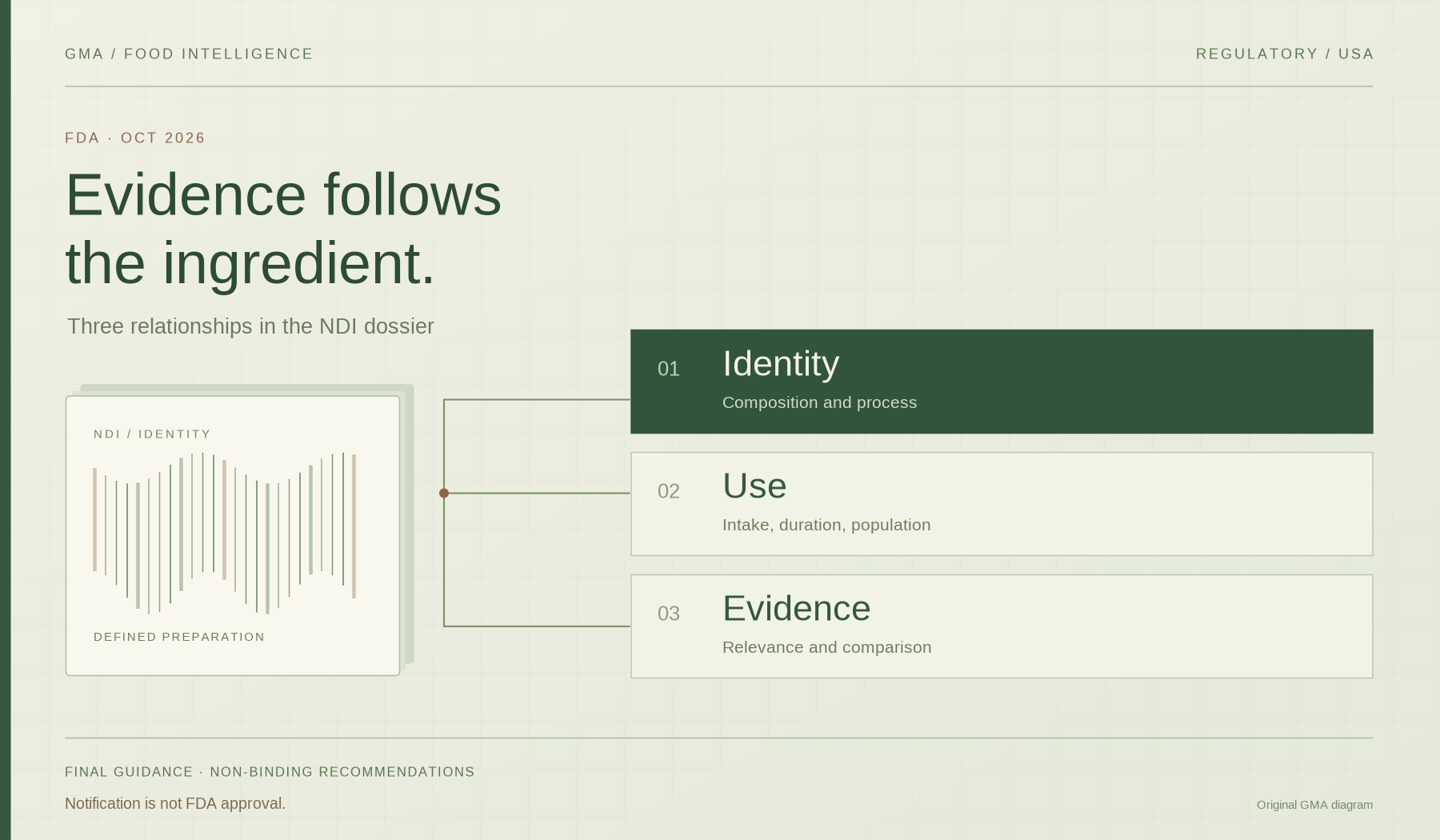
FDA has finalised its recommendations on identity and safety information for new dietary ingredients. Evidence needs to relate to the preparation and uses described in the notification. The guidance is non-binding, and the NDI process does not grant product approval.
An extract can carry the name of its source plant while concentrating its constituents in different proportions. When a business uses studies on the plant to support the safety of the extract, that step needs explaining. It is one of the questions addressed in the final guidance announced by the Food and Drug Administration on 19 October for new dietary ingredient notifications in the United States.
The document finalises recommendations on identity, history of use or other safety evidence, and the basis for the conclusion of safety, previously set out in Sections VI.A–VI.C of the 2016 revised draft. FDA is completing that guidance in stages; other sections remain to be finalised. The new document sets out the agency’s thinking and is not legally binding. Obligations arise from the statutes and regulations cited in it.
Notification and the 75-day period
In the US system, a New Dietary Ingredient (NDI) is a dietary ingredient that was not marketed in the United States in a dietary supplement before 15 October 1994. Where notification is required, the manufacturer or distributor must submit it at least 75 days before introducing the product into interstate commerce. That timing comes from the existing legal framework, rather than this guidance. Nor is the notification an application for authorisation: FDA explicitly states that the process does not grant approval.
Manufacturing is part of identity
The first question is what the ingredient actually contains. Alongside its name and a description of the product, FDA recommends information on composition, analytical methods, batch variability, and relevant impurities and contaminants. Manufacturing belongs in the discussion where it helps establish identity and safety: extraction solvent, temperature, concentration or purification can explain how the starting material becomes the final preparation.
For a botanical, the species and plant part are essential to that description. For an extract, the guidance also recommends documenting its relationship to the starting material, solvents, relevant markers and standardisation. Collecting papers that mention the same botanical name is therefore only a starting point. The dossier needs to establish which preparation was studied and how it relates to the one being proposed.
Three relationships to make traceable.
A GMA teaching example based on FDA’s whole-herb and extract comparison. Explore the questions and their references in the guidance.
The name does not fully define identity.
A tested material and a proposed ingredient may come from the same plant yet differ in composition. The guidance asks notifiers to explain that relationship.
- Species and plant part
- Process and solvents
- Composition and specifications
Exposure connects serving size and duration.
A history of use is relevant when the dossier explains how it relates to the proposed use. Higher intake, longer use or a different population may leave gaps to address.
- Serving size and frequency
- Duration and total exposure
- Population and restrictions
The connection needs a rationale.
The safety narrative interprets the evidence. Where the tested material differs, a qualitative and quantitative comparison needs to explain why the results support the safety conclusion.
- Similarities and differences
- Relevance of cited evidence
- Gaps and further evidence
Evidence needs to follow intended use
The second question concerns use. The notification must describe the intended conditions; the guidance includes serving size, frequency, duration, target population and restrictions within that description. A history of consumption at one level does not automatically support a more concentrated preparation, longer use or a different population. Meaningful differences need an explanation and, where gaps remain, further safety evidence.
The connection is made in the safety narrative: the reasoned account linking the information to the notifier’s conclusion of safety. If studies concern a related substance, FDA recommends a qualitative and quantitative comparison. The guidance specifically uses the example of a whole herb and its extract. Comparing composition, servings and daily exposure helps explain why the evidence is relevant. The finished formulation also matters, particularly where other components may alter the safety profile, for example by increasing bioavailability.
Alternative methods need a justification
The guidance also addresses New Approach Methodologies (NAMs), alternative methods that can reduce, replace or refine animal testing. FDA supports their use, while asking notifiers to demonstrate that a method is scientifically valid, fit for purpose, reliable and appropriate in the dietary supplement context. It provides scope for different tools while retaining the need to justify what each can actually measure or predict.
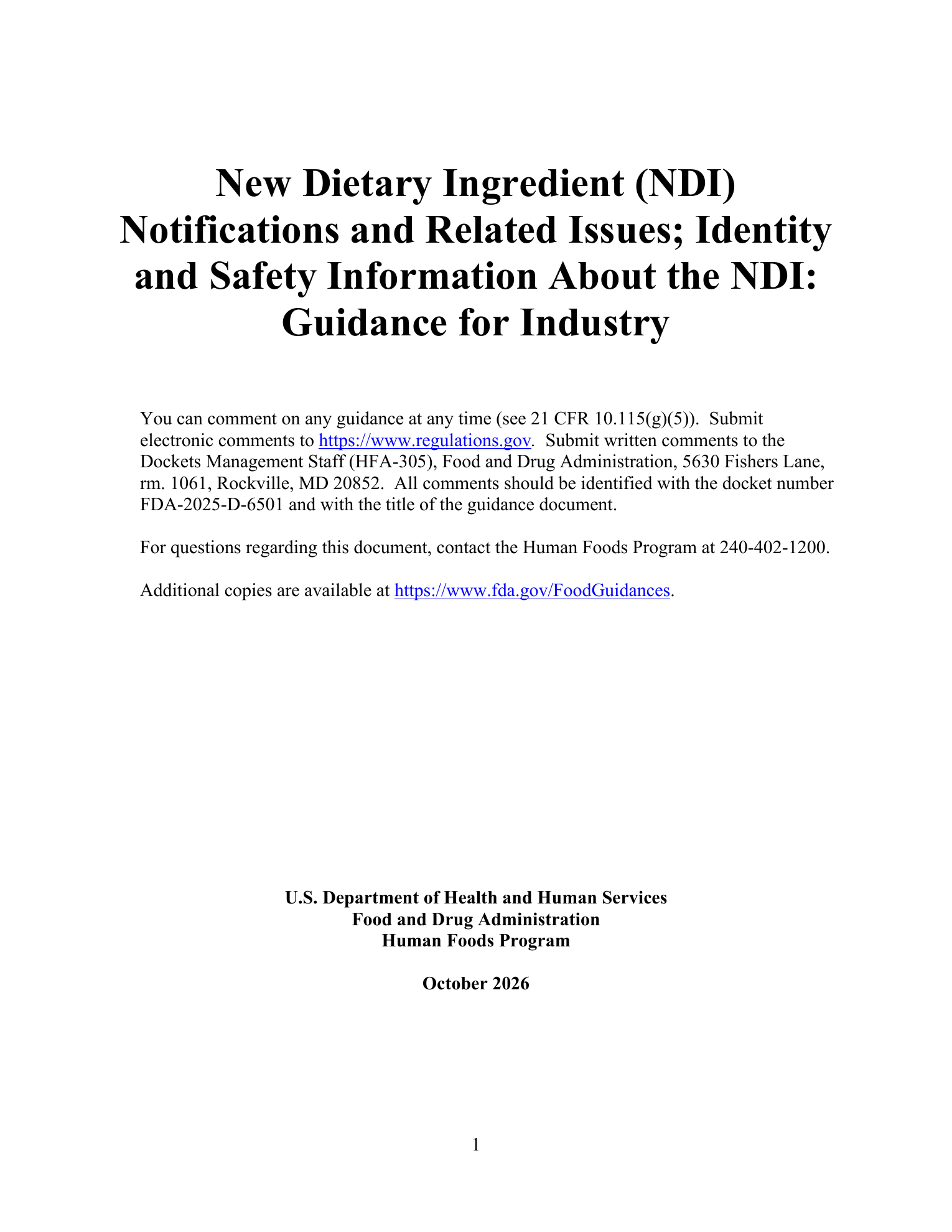
The guidance in its original form.
53 pages, October 2026. The cover reproduces the document downloaded from FDA; the PDF retains the complete English text.
- Authority
- FDA · Human Foods Program
- Status
- Final · non-binding
- Announced
- 19 October 2026
Making the connection in the dossier
For ingredient suppliers and supplement developers serving the US market, the practical implication is shared work between quality, research and regulatory teams. Specifications and studies need to describe comparable materials, while conditions of use need to remain consistent with the exposure assessed. An Italian business must also keep this US pathway distinct from verification of status and conditions of use in the European Union. Before adding another paper to the dossier, the useful question is whether the evidence already collected actually concerns the ingredient and use being proposed.
For a business preparing an ingredient for the US market, the dossier needs to make the relationship between the tested material, the supplied ingredient and the intended use in the finished product traceable.
The document concerns notification content within the US system. It finalises selected sections of the 2016 revised draft; other sections remain unfinished. It does not change European authorisations.
Editorial note. This content is intended for industry professionals. It does not constitute medical advice, therapeutic guidance or regulatory advice. Read our editorial method.
Read the original source · U.S. Food and Drug Administration